Money stuck in a smart contract or sent in error: what can actually be done
Published: Last reviewed: How we edit
A confirmed blockchain transfer is final. No one can undo it. Funds sent to the wrong address or trapped in a faulty smart contract come back only if someone with control chooses to act. That could be a protocol team with an admin function, an exchange holding the receiving address, or a wallet owner. We check the options, reach the right party and document your case.
Got a question about your case? Ask us here:
The hard facts about our limits
- On-chain transfers, once confirmed, are final. We cannot reverse, cancel or edit a transaction, and no one else can either.
- Most cases rest on a protocol team, an exchange or the receiving party choosing to help. We cannot make them act. That choice stays theirs.
- No return is promised here. Sometimes the truth is blunt: the money cannot be recovered. We tell you that up front, before you spend another cent.
- No exploiting bugs, no attacking contracts, no pulling funds out of contracts you do not own. In many places that is a crime, and it would wreck your own case.
- All of our work relies on data anyone can see. We will never ask for your seed phrase, private key or password, and you should treat anyone who does as a red flag.
You should use this service if
- You might have sent tokens using the wrong address, an incorrect network, or the wrong contract address for that specific token.
- Funds sit in a contract that no longer allows you to withdraw
- A bug or exploit hit your deposit and the team has gone quiet
- You built a small project, and a flaw in your contract cost your users their funds
- You want a straight answer on whether a return is realistic before spending more
Common issues
- You sent tokens to an address on the wrong blockchain, but that address works on a different chain
- Coins sent to the token's contract address rather than a wallet address
- A staking or vesting contract that holds tokens after an upgrade or pause
- A protocol exploit emptied a pool holding your deposit
- A typo or lookalike address, and the recipient turns out to be a real wallet owned by a stranger
- A failed transaction that still charged the fee and left you unsure where your assets went
- A deposit sent to an exchange address that doesn't support the token you sent
How we help
- Pin down exactly what happened on-chain
We go through the transaction on a block explorer together: sender, receiver, network, token, contract, status. Cases that look gone sometimes turn out to be pending, sitting on another chain, or held at an exchange address.
- Figure out who controls the destination, if anyone
First we identify what the receiving address actually is: a personal wallet, an exchange deposit address, or a smart contract. We also work out who, if anyone, can act on it. That answer determines whether any recovery route exists at all.
- Have independent specialists review the contract
Independent smart contract engineers go through the code and its permissions: admin keys, pause or rescue functions, upgrade proxies, timelocks. Their written opinion tells you whether any path back exists, and if so, who controls it.
- Contact the correct party in writing
We draft a short, factual note for the protocol team, exchange support, a bug bounty channel, or whoever controls the receiving address. Hashes, addresses, and a clear request are included, and it goes out through official channels only.
- Handle claims and legal options together
When the counterparty can be identified and the amount is worth it, an independent lawyer can review a claim or a demand letter with you. If the protocol offers a compensation plan, we help you file a claim backed by proof of your holding.
The steps in this process
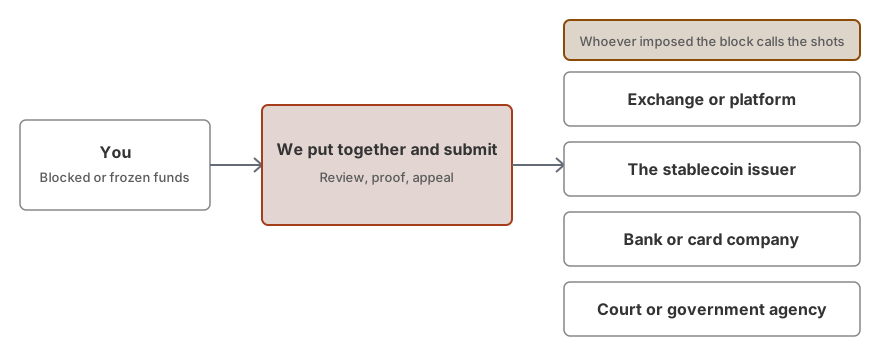
- No-cost evaluation
Send us the transaction hashes, the network, and a few lines describing what you expected to happen. You get a written answer on whether a route looks possible, or whether the funds are effectively final.
- Scope in writing, with fee
If something is worth trying, you receive the scope, the specialists, and the fee model before paying anything. If not, we tell you straight, and the matter closes at no cost.
- On-chain and contract check
The transfer gets mapped first. Independent specialists then read the contract code and its permissions. You get a plain summary showing who can act on the funds and who cannot.
- Reach out and claim
We put the approach in writing and send it to the party with the power to act. Every reply is tracked. You receive copies of everything we send and everything that comes back.
- What to expect
At the end you get a short written note covering what was tried and how it turned out. If no route is left, we tell you that plainly and close the case instead of leaving it open.
What you should have ready
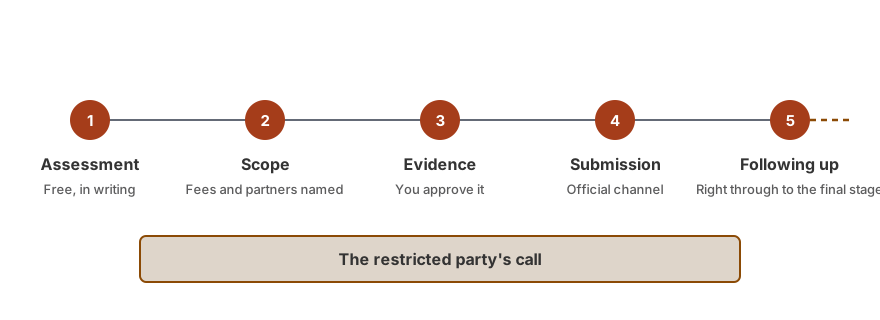
- Transaction hashes for each transfer, with the network clearly stated
- The wallet address that sent the funds, plus the receiving or contract address
- Screenshots of the app, site or exchange screen where the issue showed up
- The token's name, its contract address, and its official site or documentation
- Any messages exchanged with support, project channels or the receiving party
- Proof that the sending account is yours, like an exchange statement. Never a seed phrase or a key.
- A brief timeline: what you meant to do and what actually happened.
Time estimates
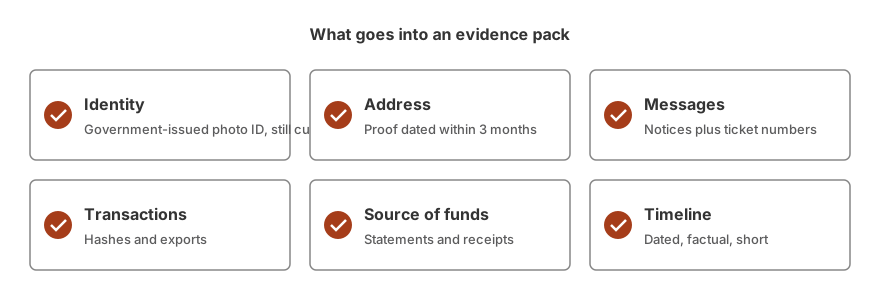
The on-chain check moves fast once you supply the hashes. What follows depends entirely on the other side: a protocol team, an exchange or an address owner might answer in days, in months, or never. We keep you posted as responses come in.
Cost Breakdown
The assessment costs nothing and shows you whether any route exists at all. If there is a way to go further, you get the scope and fee model in writing before paying, and the contract review by independent specialists is quoted separately, so you can stop at any point. Cost Breakdown →
Real questions
Can crypto be recovered after I sent it to the wrong address?
Blockchain transactions that are already confirmed cannot be undone by anyone. Getting funds back depends entirely on whoever controls the receiving address choosing to return them. If an exchange holds that address, support may assist. If it is a private wallet and the owner is unknown, there is generally no path forward.
I sent tokens over the wrong network. Are they gone?
Not always. When the receiving address also exists on the other chain and belongs to an exchange or a wallet provider, that party may be able to return the funds, sometimes charging a fee. But if no one controls that address on that chain, the tokens are typically lost permanently.
What happens if I sent tokens straight to the token's contract address?
Getting these back is very difficult. A large number of token contracts simply lack any function that releases tokens stuck in them, so the balance sits there. Certain projects include a rescue function or can intervene through governance, so checking the code and reaching out to the team is worthwhile.
Can a technical specialist fix a smart contract bug to return your funds?
Occasionally, yes. If the contract can be upgraded, or includes a pause or rescue function, the team holding those keys may act, and some protocols launch compensation programs after an exploit. But nobody can fix a contract that was built without any way to change it.
Is it possible for you to hack the contract and pull my funds out?
No. Taking advantage of a contract is against the law in many places, and it can pile new losses on old ones. Anyone pitching it to you fits a classic red flag. We stick to lawful routes: reading the code, reaching the right party, and where it helps, advice from an independent lawyer.
Will you ask for my seed phrase to check my wallet?
No. All our work runs on public data like hashes and addresses. No honest specialist will ever ask for your seed phrase or private key. If anyone does, stop right there and treat it as a scam.
Related situations
- When a DeFi exploit or bridge hack hits: what we do. After a DeFi exploit, bridge hack or bad approval: tracing, alerts and reports.
- Blockchain analytics report, explained plainly. Traced transaction evidence for a source-of-funds report, built for compliance review.
- Tracing stolen crypto, sending freeze requests. Trace stolen crypto, request freezes at exchanges and issuers, file a police report.
Read next
Sources
These come from official or authoritative pages. Since pages can change, verify the current wording at the source.
- Introduction to smart contracts · ethereum.org
- Upgrading smart contracts · ethereum.org
Everything on this page is general information. It is not legal advice.