What documents a compliance team at an exchange will request, and how to submit them
Published: Last reviewed: How we edit
When an exchange runs a KYC or AML review, expect four document groups: a current photo ID, proof of your address, proof of where the money came from, and evidence you control the wallet in question. Put clear, recent files in one tidy package, add a brief cover note tying every document to the specific question, and never include passwords, seed phrases or private data nobody asked for.
Got a question about your case? Ask us here:
Answer the question first, then open the folder
Before gathering a single file, reread the request. The exchange spells out what it needs, often in a single line. An identity check refresh calls for different paperwork than explaining a large deposit.
Turn each question into a written list. Every file you collect should speak to one item on it. Anything vague? Ask the exchange to clarify in writing before you send a big package.
Identity and proof of address
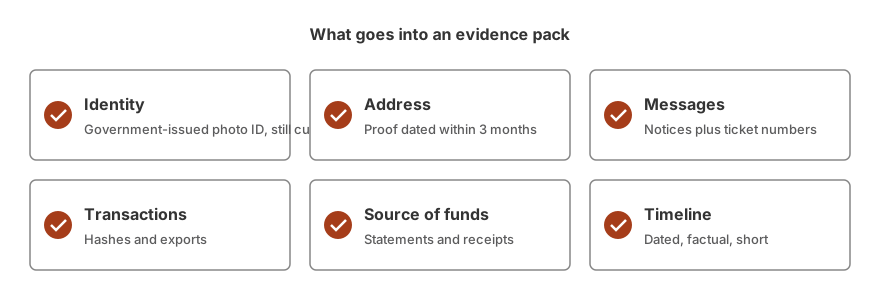
These files are the easiest to gather, yet small details trip up plenty of reviews. Anyone reviewing your case cross-checks the name, birth date and address on every single document.
Use up-to-date documents that spell your name exactly as it appears on the account. If your name has changed, attach the record that proves it.
- A valid, unexpired government photo ID, shown with every corner in view.
- Proof of address no older than three months, for example a utility bill or bank statement, but only if the exchange requests it.
- A sharp selfie or a live video check if asked for, shot in decent light and without any filters.
- Documentation of a name change, for instance a marriage certificate, when the names across your files do not match.
- Business registration papers plus a list of who owns the company, in cases where the account is held by a business.
Where your funds came from
Reviews stall here most often. The exchange needs a paper trail running from where the money started to the deposit that set off the review. Our separate guide explains how source of funds differs from source of wealth.
Pick records that reflect where the money truly came from. A payslip plus a bank statement proves salary income. Trading income shows up as an exchange export from earlier plus the bank transfers behind it. If the funds came from more than one source, document every piece on its own.
- Bank statements proving the money moved into the exchange or into the wallet.
- Statements from the exchange and transaction exports from platforms you used before.
- Contracts of sale, invoices or receipts for payments tied to goods, services or property.
- Tax filings or payslips if the money traces back to earned income.
- A short written note covering anything the documents leave out.
Showing the wallet is yours
If a self custody wallet is part of the review, the exchange can ask for proof that the address belongs to you. You can provide this without giving up any secret.
Common options: a signed message from the address, a small test transfer in an agreed amount, or a live screenshot of the wallet displaying the address. Use whichever method the exchange will take. Never hand over your keys.
Format and presentation advice
A clean package makes you look like a dependable customer. A sloppy one brings extra questions and delays. Keep one file per document, PDF where you can, named clearly like bank-statement-2026-03.pdf.
Include a one page cover note that lists each file and states which question it answers. Stay factual and brief. In that same message, do not argue, threaten or complain.
- Scan or photograph in colour, complete, edges included, with no glare.
- Leave out no edits, retouching or redactions the exchange did not approve.
- Compress files to fit the upload limit rather than chopping a statement into many images.
- Use only the channel named in the ticket, and hang on to the reference number.
- Save copies of everything you sent, plus the dates.
What not to send
Sending more is not better. Private data you hand over unnecessarily puts you at risk and buries the reviewer in noise. Skip anything the request never asked for, unless it directly supports a point.
Nobody from a real compliance team will ever ask for your seed phrase, private keys, wallet passwords, one time codes or access to your computer through remote tools. Handing any of those over hands your funds to a thief. Also do not submit altered documents, or paperwork belonging to another person, unless that person has agreed to it.
Frequently Asked Questions
How new does a proof of address need to be?
Plenty of exchanges want a document dated within the last three months, though each platform sets its own rule. Read the request carefully. If it names no period, submit the newest document you have.
Am I allowed to redact sections of a bank statement?
Sometimes, if the exchange permits it. You can often cover unrelated entries, but your name, the account number or IBAN, the date range, and the lines that matter need to remain readable. Check with them before you edit anything: a document that looks tampered with may be refused.
What steps should I take when I lack documentation for a prior transaction?
Be upfront about it and hand over the nearest real substitute: an older export from the exchange, a bank statement, or a signed note from the other side. An honest explanation beats a made-up document every time.
Is it better to submit everything in one go, or share papers bit by bit?
Send one complete package that covers every question in the request. Drip-feeding partial replies causes confusion and can restart review timers. If something in the request cannot be met, say so in the cover note.
Do I need to translate my documents?
Often yes, when they are not in a language the exchange accepts. First ask if a plain translation is enough or if a sworn one is required. Always send the original file alongside the translation.
How we can help
- Proof of funds and wealth origin packs. Prepare a clean source of funds and source of wealth pack that exchanges, banks and processors will accept.
- Unblocking an exchange account. Decode the freeze, build KYC/AML evidence, answer compliance, file the appeal.
- Who froze my crypto? A freeze diagnosis. Name who froze your funds, then see what can realistically be done.
- Wallet screening flags and risk disputes. Flagged high risk by screening tools: document the funds path and dispute it.
Everything on this page is general information. It is not legal advice.