
USDC address blocked: how the Circle blacklist works and your next steps
Published: Last reviewed: How we edit
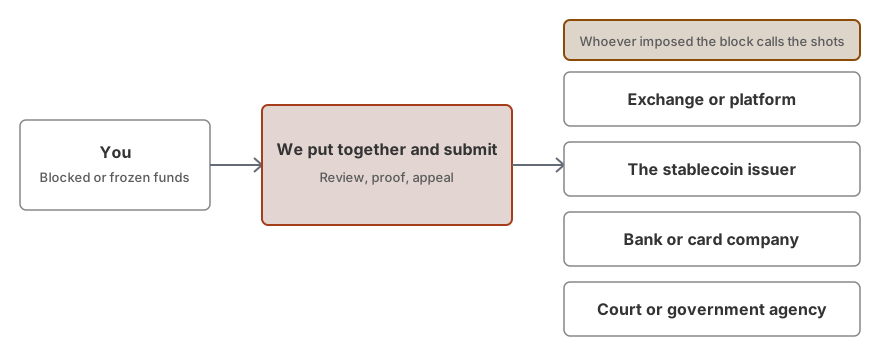
Nobody can promise to get these tokens moving again. Here is the truth: an issuer can put a USDC address on its blocklist, which freezes transfers while the balance still sits on-chain. Circle is the party holding that switch. Typical causes are a legal order, sanctions screening and risk flags. Wallets, exchanges and block explorers have no power to undo it. The realistic path is a documented request to the issuer, often with a lawyer handling the paperwork.
Got a question about your case? Ask us here:
Clues the block sits on the address, not your app
Your wallet displays the USDC balance, yet every transfer fails. Decentralised swaps fail too. Tokens in that same wallet move without trouble. That pattern points at the USDC contract itself, not at a broken wallet app.
Hold off on blaming a blacklist until you've checked the boring stuff. A wrong network, an empty gas balance and a congested chain all cause failed sends too.
- Move a small amount of a different token from the same address. If that goes through, your wallet is fine.
- Open the failed transaction on the block explorer and read the actual error message.
- Where the chain data supports it, look up the address in the blocklist events on the USDC contract page.
- Take screenshots, and keep the date and time visible on each one.
How issuer blacklisting works, in plain terms
USDC is a stablecoin issued centrally, under regulation. Its contract contains a function that allows the issuer to place an address on a blocklist. Once an address is on that list, it can no longer send or receive the token on that network.
This is a built-in feature of fiat backed stablecoins. It is not a bug and not a hack. The point is to let the issuer act on legal orders and sanctions rules. The hard part: a decision made in one office can freeze funds in a wallet only you control.
What typically leads to a blocklisting
The issuer seldom explains any single decision. Public discussion points to a few common triggers. Read this as a map of possibilities. It is not a diagnosis of your case.
- A court order, or a directive from a public authority connected to an investigation.
- When sanctions screening flags an address because it ties to a listed person or service.
- Exposure, found by blockchain analytics, to addresses tied to fraud, theft or hacks.
- A request from an exchange or bank that works with the token.
Who makes the call, and what they review
The issuer holds the decision, and at times so does the authority behind a request. Neither usually talks case details with anyone who lacks a mandate from you.
A review usually traces where the money came from, who held it before you, and whether each transfer has a clear commercial or personal reason behind it. Missing pieces in that story are what drag a case out. Proof of where the funds came from is the strongest card you can play.
Steps you can take
The main path is a written request to the issuer through its official legal or support channel. It should carry your identity, the address, the dates, and evidence of where the funds originated. When an authority is involved, a lawyer in that jurisdiction may need to file the request.
Results differ. The address might be unlocked, stay frozen, or the issuer may state that only a court can rule. We make no promises about any of these outcomes, and we cannot force the issuer to move.
- Build a timeline showing how the USDC reached the address.
- Gather your evidence: statements from the exchange, bank transfer records, invoices, and any contracts.
- Show you control the address without exposing your keys, for example with a signed message.
- Send one full request. Not several small ones.
- Never hand anyone a seed phrase, private key or password. Ever.
What not to do while you wait
Moving flagged funds in test amounts to fresh addresses is a bad idea. So is mixing or bridging whatever you still control. Both raise new questions, and both can look like you are trying to hide where the money came from.
Watch out for anyone claiming ties to the issuer, or offering to unblock your address for a payment. That is a red flag. If you want a second set of eyes on your documents before you contact the issuer, we do a free assessment and can loop in independent lawyers.
Frequently Asked Questions
Can an exchange lift the block on my USDC?
No. An exchange has no power over a restriction written into the token contract. The only thing it controls is what happens to funds sitting on its own platform. The one party that can change your address status is the issuer.
Does a Circle blocklisting last forever?
We cannot tell you. Some restrictions get lifted after a review. Others stay in place while a legal matter is open. The issuer, or a court, decides the outcome. So ask the issuer directly what applies to your address.
Will the issuer explain why my address was blocked?
Authority requests often come through in general terms, and they might withhold details entirely. A lawyer can access more information via formal request than a private individual.
Can you deposit fresh USDC funds into the frozen address?
You generally cannot receive new assets. A blocklisted address is restricted from both incoming and outgoing transfers. Don't ask anyone to send funds there, as they may get stuck too.
Must I hire a lawyer to communicate with the Circle issuer?
A private request with solid evidence works for some simple cases. A lawyer is needed when the amount is high, an authority caused the block, or your initial attempts fail.
How we can help
- Appealing a stablecoin issuer's freeze. Build an evidence-backed appeal to Tether, Circle or any stablecoin issuer.
- Wallet unblocking for large cases. Frozen or flagged wallets: we build and present the case. Cases start at USD 50,000.
- Blockchain analytics report, explained plainly. Traced transaction evidence for a source-of-funds report, built for compliance review.
- Help when sanctions or AML flags hit your funds. AML or sanctions match issues? Get the evidence and a lawyer-filed statement to remove the flag.
Everything on this page is general information. It is not legal advice.