Circle (USDC) address blocked or frozen: what the official pages say
Published: Official pages last read: How we edit
Nobody can promise a blocked address gets freed. Here is what Circle itself says: it may block an address from sending or receiving USDC in limited cases, mostly legal orders, urgent government requests or security threats. Blocklisting is not a reversal of a completed transfer. It may lift the block once an authority ends the order or the security problem is resolved. If your funds moved without your consent, Circle says to contact law enforcement first.
We have no ties to Circle (USDC). We are not affiliated with it, cannot shape its decisions, and nothing here is an official statement from Circle (USDC).
Got a question about your case? Ask us here:
Here is what the platform states
- According to a Circle help article, in certain limited circumstances the company may stop a single blockchain address from either sending or receiving USDC or EURC. This is laid out in its Stablecoin Access Denial Policy. [1]
- The same article makes clear that blocklisting, also called access denial or freezing, is not the same as reversing a transaction. USDC and EURC transfers cannot be undone, so Circle cannot reverse or recall a payment that has already gone through. [1]
- Circumstances on the list: following US or French laws and valid orders from a court or authority there, answering certain urgent government requests, and steps Circle takes when it judges, at its own discretion, that a security threat calls for action. [1]
- The article also notes that transfers to or from a blocked address can fail, and that funds tied to that address may stay out of reach for as long as the blocklisting remains in place. [1]
- Circle states that an address can be taken off the blocklist once the proper authority formally confirms a legal duty or order has been lifted, or when a security incident no longer calls for the restriction. [1]
- Per that article, if someone moved your funds without your OK, you should report it to law enforcement where you live right away. Bring the sending and receiving addresses, the transaction hash, when it happened, and how much was involved. [1]
- Per the article, law enforcement can submit valid legal process directly to Circle, which evaluates it under its policy and applicable law. [1]
- In its v2.2 announcement, Circle states that the blocklisting feature of its smart contracts allows Circle to stop specific addresses from sending and receiving USDC and EURC, and that this follows its Access Denial policy. [2]
Common restrictions
| Kind of restriction | What it means |
|---|---|
| Address frozen by legal order | Circle can freeze an address to comply with laws or a valid legal order from a court or recognized authority. The block lifts only when that authority confirms the order no longer stands. |
| Blocked address after an official government request | Circle states it may act on certain urgent government requests. The article gives no details on how that request process works, so the path runs through the authority, not the holder. |
| Block over a security threat | Circle states it may block an address when it decides, at its sole discretion, that this is needed to protect the security or reliability of its network. The block may be removed once the incident no longer requires it. |
| Money stuck at a blocked address | Transfers going to or from a blocked address can fail, and while the block stays in place you may not be able to reach the funds. Circle states that a block does not reverse a transfer. |
What you can do, step by step
- Check that the address is really blocked
A transfer can fail for reasons other than a block. Look at the transaction details first, then ask your wallet provider or exchange if the error points to a restriction on the address.
- Find out the reason
Reach out to whoever told you about the freeze, whether that was an exchange, a platform or an official body, and ask what triggered it. Could be a court order, a request from a government, or a security concern. Circle's article names those as the main grounds.
- Gather proof of ownership and origin
Get documents showing you control the address, plus records of where the funds came from. You will need these with any party you deal with.
- Get a lawyer when an order is behind it
Here is the hard part. A block on a crypto address usually comes from a legal order. It stays until the authority that ordered it says it can be lifted. A lawyer can contact that authority to check.
- Tell the police about the theft first
If someone moved your USDC without permission, Circle says to report it to local law enforcement right away. Bring the addresses, the hash, the date, the time and the amount.
- Contact Circle support only via official pages
Circle's own help page gives you a contact path. Use circle.com to get there. Never click links from strangers who message you.
What you should have ready
- Write down the specific address that is blocked and the token name.
- Transaction hashes, plus the dates, times and amounts involved
- Evidence showing the address is under your control
- Documentation tracing where the funds originated
- Include any official notice or order you received from an authority or platform.
- You must include a police report number if your funds moved without permission.
Scams and red flags to avoid
- Anyone who claims they can get your address off a blocklist has no right to your seed phrase, your private keys, or your passwords. Never hand them over.
- Never pay people who promise immediate removal of your funds. Unblocking is decided by an authority or a specific security incident, it is not a purchasable service.
- Sites that want your wallet connected so they can check or unlock an address are a red flag. They can drain your funds.
- Unsolicited messages offering to recover stolen USDC deserve suspicion. Circle states that once a transfer is complete, it cannot be reversed or recalled.
When external help is required
- The block seems tied to a legal order or an investigation
- A large balance is stuck, and nobody can tell you who holds the restriction
- An authority or lawyer needs your proof of control and origin, organised
- Your funds were stolen, and the police need the facts documented fast
Real questions
What reasons could Circle have for blocking my USDC address?
Here is the hard part. Circle's article names three kinds of reasons: staying compliant with the law and orders that are legally valid, certain urgent requests from governments, and its own call, made at its sole discretion, that a security threat makes a block necessary. It does not explain how any single address gets picked.
Can Circle undo a USDC transaction?
No. Circle's article states that USDC and EURC transfers cannot be undone once completed, and Circle has no way to reverse or recall them. Blocklisting stops an address from sending or receiving, which is a separate matter.
Can a block on an address be lifted?
Circle may remove a blocked address under specific conditions. A block ends when a formal authority confirms a legal order is no longer applicable. It also happens when a security incident no longer requires the restriction.
My USDC was stolen. What now?
Circle's own article says you should report it to local law enforcement right away. Bring the sending and receiving addresses, the transaction hash, the date, the time and the amount. Once police act, they can serve Circle with valid legal process.
Does Circle offer an appeal form for blocked addresses?
The help article lays out the grounds and the conditions for removal and points to a general contact route, but no dedicated appeal form is described there. When a block is tied to a legal order, the authority and a lawyer are the usual path.
Is Circle required to notify me of a block?
The help article makes no statement promising notification. If your platform informed you of a block, ask what notice it received and who sent it.
Is this page run by Circle?
No, it is not. We are independent of Circle and have no tie to them. What we do is go through Circle's own pages, link to them, and we have no say at all in any decision made about an address.
Related services
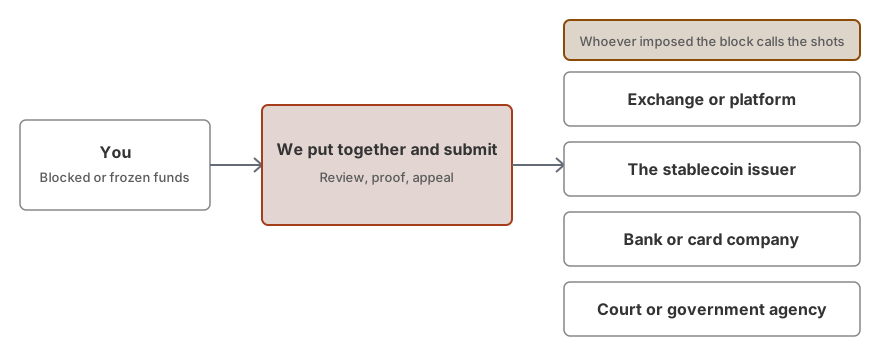
- Appealing a stablecoin issuer's freeze. Build an evidence-backed appeal to Tether, Circle or any stablecoin issuer.
- Wallet unblocking for large cases. Frozen or flagged wallets: we build and present the case. Cases start at USD 50,000.
- Tracing stolen crypto, sending freeze requests. Trace stolen crypto, request freezes at exchanges and issuers, file a police report.
Read next
Official pages read
These come from official or authoritative pages. Since pages can change, verify the current wording at the source.
- Understand Circle's stablecoin blocklisting process · Circle
- Announcing USDC v2.2 · Circle
Everything on this page is general information. It is not legal advice.