Counterparty checks and risk assessment for crypto businesses
Published: Last reviewed: How we edit
Before you send funds, due diligence asks the hard questions: who actually owns the counterparty, where its money comes from, whether it or its wallets carry sanctions, fraud or adverse media exposure, and what risk that adds to your deal. We coordinate independent specialists who put their findings in writing, based on evidence. The result supports your decision. It is not an audit, not a legal opinion, and not a promise that a counterparty is clean.
Got a question about your case? Ask us here:
The hard facts about our limits
- A due diligence report is not an audit, a credit rating, legal advice or proof of good standing. It only records what the sources showed on the review date.
- We do not access private records, and nothing here is gathered illegally. What we find comes from public sources, documents you give us and tool output, and that picture can be incomplete.
- We do not decide approvals for you, and no bank, regulator or counterparty has to accept our rating. We cannot promise any counterparty is risk free.
- Our report is one input among many for your decision. We are not auditors or lawyers, and we do not give legal advice.
- Nobody at our side will ever ask you or the counterparty for a seed phrase, private keys or passwords, and we never need access to your funds.
You should use this service if
- A crypto firm preparing to bring on a corporate client, an OTC desk or a liquidity partner
- Crypto company founders checking out another firm before a deal, purchase or investment
- Finance teams taking large crypto payments who need to confirm the sender is acceptable
- Compliance teams that must put a written risk rating on file for a high-risk client or a market they are entering for the first time
- Treasury teams that need to vet the exchanges and wallets they rely on
Common issues
- A potential partner won't tell you who owns the company or where its funds come from
- A customer's wallet has indirect links to a mixer or a sanctioned service
- You want to enter a new country or add a token and need a documented risk view
- Your bank asked how counterparties get assessed and requested an example
- A target company claims it is licensed and compliant, and you need to verify that
- A big OTC trade sits waiting for your sign-off while the counterparty's paperwork is incomplete
- Your periodic review of high-risk customers is past due
How we help
- Set the question and your risk appetite
We put in writing what you need to decide, by what date, and how much risk is acceptable. That way you don't get a long report answering a question you never asked.
- Verify ownership, identity and licence claims
Independent specialists check company registries, who owns the entity, its directors, claimed licences or registrations, and public records where the law allows. Anything that contradicts what the counterparty told you gets flagged.
- Check people, companies and wallets
Sanctions lists, PEP data and adverse media get checked, and blockchain analytics tools look at wallet exposure. A real person then reads every hit, because automated matches can be wrong or stale.
- Score the risk and back it with evidence
You get a plain rating for every risk area, the evidence behind it, what could not be confirmed, and the questions worth asking the counterparty. These ratings are the specialists' professional judgement, and you can see how they reached it.
- Back your decision and your records
Your team gets help turning the findings into a written decision record: approve, approve with conditions, request more information, or decline. It goes into your files, ready when a bank or auditor asks.
The steps in this process
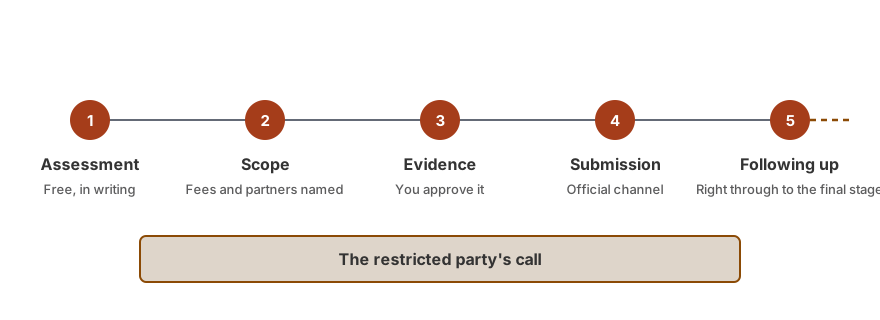
- No-cost evaluation
Send us the name or entity to assess, plus your deadline. First we confirm in writing whether independent specialists can actually answer your question, and what information they would need to do it.
- Scope in writing, with fee
You get the scope, the sources the specialists will use, the exact deliverable and the fee model, all in writing. Nothing starts until you approve it.
- Needed Documents
The specialists send you or the counterparty a document list with questions. We keep track of what came in and what is still missing.
- Check and report
Specialists verify the sources, screen the parties and the wallets, then produce the report. We read it for clarity and flag any statement the evidence cannot back up.
- Recap
We go over the findings with your team, answer what comes up and agree on next steps. The final call stays yours.
What you should have ready
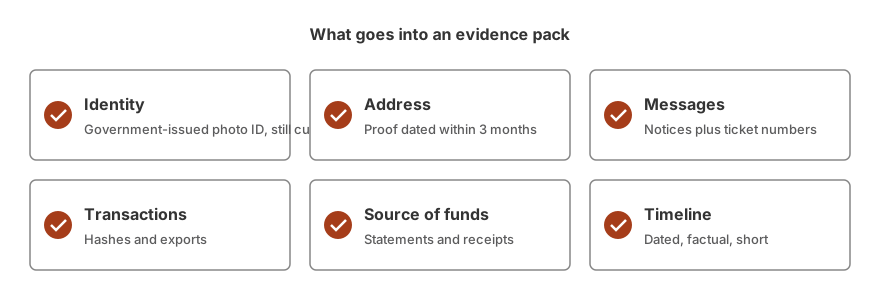
- Name, registration number and country for every company or person being assessed
- Corporate papers, such as the certificate of incorporation, an ownership chart and the list of directors
- Proof of any licence or registration the counterparty claims to hold
- Exchange accounts and wallet addresses the other party intends to use
- Deal specifics: purpose, amounts, currencies and timing
- Your risk tolerance, onboarding rules and any rating criteria you already work with
- Past screening results, news coverage or complaints you are already aware of
Time estimates
Timing depends on how many parties are involved, which countries come into play and how fast the documents land on our desk. One simple counterparty moves quicker than a group with several ownership layers. Dates are set together with you in the written scope.
Cost Breakdown
The assessment costs nothing. Every review gets a written quote for a fixed scope, with the specialists' fees listed on their own line. Payment comes only after we confirm whether we can help and you accept the quote. Cost Breakdown →
Real questions
How does KYC differ from due diligence?
KYC is the basic identity check you run on a customer. Due diligence digs deeper into one counterparty or one deal: who owns it, where the money comes from, reputation, wallet exposure, and why the relationship exists. When risk is higher, you step up to enhanced due diligence, with more evidence and a senior person making the call.
What does enhanced due diligence mean?
Enhanced due diligence is the deeper review you run when risk is higher. Think politically exposed persons, high-risk countries, or odd ownership structures. It demands more documents, checks where the funds came from, and gets a senior decision on record. Which cases require it depends on the jurisdiction.
Can you tell me if a wallet is safe to receive funds from?
Nobody can promise a wallet is safe, and we will not pretend otherwise. Analysts can check its exposure to categories like sanctions, mixers, scams or darknet services and walk you through the path. Screening shows risk indicators as of the check date. That is not a verdict on the owner.
Do you look into beneficial owners?
Specialists compare the ownership details your counterparty gives you against public registers, where those exist. Some countries keep their registers limited or closed. When ownership cannot be verified, the report says so plainly and flags it as a risk factor.
Will the counterparty find out they are being checked?
In most cases, yes, since we have you ask the other party for documents. Public record checks happen without reaching out to them. Your written scope lists every step that involves contact, and your onboarding terms should state upfront that screening will occur.
How often should due diligence be refreshed?
That comes down to your policy and the risk level. Riskier relationships get reviewed more often, and certain events can force a new one: a new owner, a news story, a sanctions update. We help you set a simple schedule and stick to it.
Related situations
- Crypto business AML compliance consulting. Independent specialists assist you in reviewing or authoring AML policies and risk assessments.
- Crypto transaction monitoring help for your firm. Plan your scenarios, alert levels and review steps for both on-chain and off-chain activity.
- Blockchain analytics report, explained plainly. Traced transaction evidence for a source-of-funds report, built for compliance review.
- Proof of funds and wealth origin packs. Prepare a clean source of funds and source of wealth pack that exchanges, banks and processors will accept.
Read next
Sources
These come from official or authoritative pages. Since pages can change, verify the current wording at the source.
- Guidelines amending the ML/TF Risk Factors Guidelines (EBA/GL/2024/01) · European Banking Authority
- EBA publishes final revised Guidelines on money laundering and terrorist financing risk factors · European Banking Authority
- Application of FinCEN's Regulations to Certain Business Models Involving Convertible Virtual Currencies (FIN-2019-G001) · Financial Crimes Enforcement Network (FinCEN)
Everything on this page is general information. It is not legal advice.