
When a relative dies or loses capacity, their crypto can be out of reach
Published: Last reviewed: How we edit
When someone dies or can no longer handle their own affairs, relatives frequently cannot locate or unlock their crypto. The lawful route is real: legal paperwork, a careful search for wallets and exchange accounts, then the exchange's own process for deceased accounts. Independent lawyers handle the legal side, and independent specialists handle the technical side. We coordinate them. Here is what we do not do: hack, guess passwords, or bypass security.
Got a question about your case? Ask us here:
Technical work on this service is done by independent partner specialists. We vet them, coordinate the case and stay your single point of contact.
The hard facts about our limits
- No one can make an exchange unlock an account, and we never claim crypto will turn up. Without keys, some assets stay out of reach for good.
- We do not break into accounts, try to guess passwords, or get around security. Our work stays inside the law and the platform's official process.
- Legal advice is given by independent, licensed lawyers, not by us. The rules differ from one country to the next.
- Nobody here will ever ask for a seed phrase, private keys, or passwords, and that covers the deceased's as well as yours.
You should use this service if
- A relative died, and you think they held crypto but have no idea where
- You know an exchange account exists, but the platform wants documents you cannot provide
- A relative can no longer handle their affairs, and you need legal access to manage what they own
- You are handling an estate. You need a plan for accessing digital assets.
Common issues
- A family member has died, leaving an exchange account nobody can unlock
- Hardware wallet found in someone's belongings, with no PIN or seed phrase recorded anywhere
- Emails or bank statements pointing to crypto purchases, but nothing that lists the wallets used
- An exchange that won't deal with family members unless a court order or grant is provided
- A relative with dementia or recovering from a stroke who handled their crypto entirely on their own
- An encrypted wallet file sitting on an old computer from the estate
How we help
- Trace what might be out there
Together we dig through emails, bank statements, devices and paper documents, looking for signs of exchange accounts, wallets or purchases. What comes out of it is a list of platforms worth contacting and a separate list of things that may require technical specialists.
- Work out which legal authority applies
Most exchanges will ask for proof of death, evidence of your own authority, such as a court grant or power of attorney, plus identity documents. Rules vary from country to country. An independent lawyer confirms exactly what your case requires.
- Contact exchanges using their official process
When someone dies or cannot act, exchanges route you through their deceased-account or incapacity team. We prepare those requests for each exchange, with the paperwork arranged the way those teams expect. Every reply gets logged in writing so nothing slips through.
- Hand the legal and technical work to independents
Court and estate steps belong to independent licensed lawyers, not to us. When a wallet file or device is in play, vetted partner specialists may attempt lawful access. We screen them and run the coordination ourselves.
- Put the assets on record and secure them
Finding them is only half the job. We help you list every asset for the estate, move it into wallets the rightful owner controls, and build an audit trail the executor, the family and a tax adviser can actually follow.
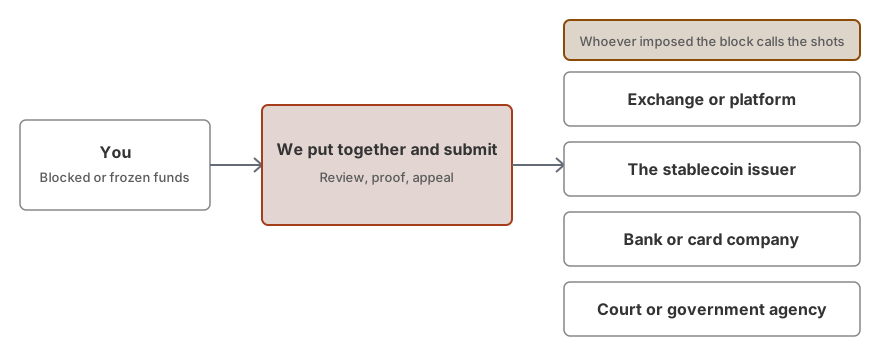
The steps in this process
- No-cost review
Be plain with us: who this person was, what you know, which papers you hold. We answer in writing with what looks possible, what a first legal step might be, and whether we can help at all.
- Written scope and introductions
If we move forward, you get a scope and a fee model in writing, plus introductions to the independent lawyer and the specialists on the case. Terms are agreed between you and each of them, directly.
- Research and legal groundwork
You collect the paperwork over a secure channel. The lawyer checks what authority you already hold and what you still need. Meanwhile we build the list of platforms and devices to approach.
- Platform requests and technical work
We notify the exchanges and coordinate with specialists if necessary. All communication is handled under written agreements, and you will receive copies of all correspondence.
- Transfer to the estate
We detail what was found, and what remains unknown. We then assist the executor or family in securing the assets before closing the case.
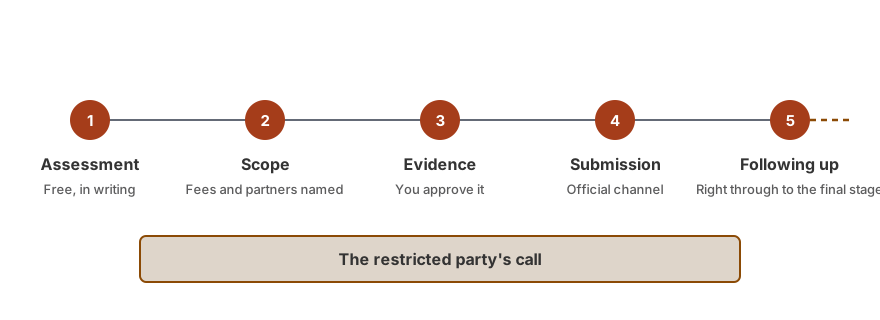
What you should have ready
- Death certificate, or medical records showing incapacity, whichever applies
- Documentation proving your legal authority, including court grants, wills, or letters of administration.
- A government photo ID and a document showing your address
- Relationship validation documents if the crypto platform specifically requests them.
- Devices, bank statements, or emails that mention known exchanges or crypto wallets.
- All available identifying information, such as crypto account names, emails, or phone numbers.
- A written list of what turns up: devices, hardware wallets, wallet files, and any paper notes.
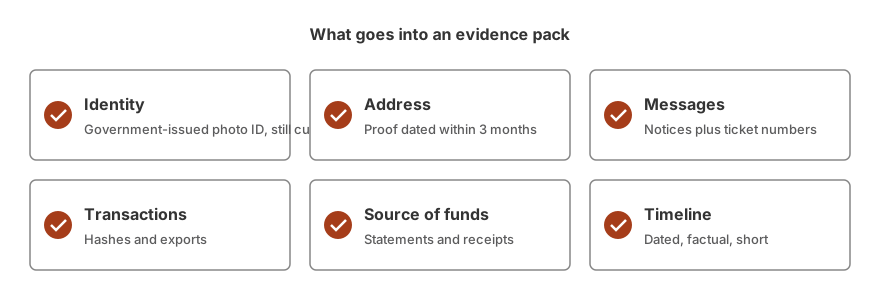
Time estimates
Estate and incapacity cases run on legal timelines and platform queues, so they often take months. Finding assets can be faster than getting an exchange to release them. After the assessment we give an estimate, and we update it as things progress.
Cost Breakdown
You pay nothing for the assessment. Lawyers and technical experts decide their own rates. Some technical work here gets paid only if something comes back, but not everyone does that. You get every fee in writing before any work begins. We never ask for money before we tell you if we can take your case. Cost Breakdown →
Real questions
How can someone access a deceased person's crypto?
Start with the paperwork and the law. You usually need proof that the person died, plus proof of your own authority, and then you go to each exchange through its own process. If the wallets are self-held, you need the keys or a lawful technical route.
What if I have no idea where the crypto is?
Start with clues. Check for emails from exchanges, bank payments to crypto firms, apps on their phones, hardware devices, and handwritten notes. Finding a list of the platforms they used is often the first real step. Be prepared for the hard part: some assets may never be found.
Can a crypto exchange discuss an account with you as next of kin?
Usually not until you show legal paperwork. Most exchanges run a deceased-account process that requires a death certificate and proof you have authority. Privacy rules often block them from sharing anything before that.
Is it possible to unlock a wallet when the password is gone?
No. Nobody can hack a wallet lawfully. If a wallet file or device exists in the estate, independent specialists can attempt lawful recovery. There is no promise it works. If both the keys and the password are gone, the funds may be out of reach for good.
Is legal guidance necessary when addressing complex crypto asset issues?
Often, yes. Handling an estate or a person who cannot act is a legal question, and each country sets its own rules. A licensed independent lawyer checks what documents you need, and we handle the coordination from there.
What steps can I take now so my family does not face this?
Here is what works: keep a safe record of where your crypto sits, and let one trusted person know how to find it. Never store seed phrases in plain notes. Talk to a lawyer about a will or power of attorney that covers digital assets.
Related situations
- Recovering wallet passwords and files. Forgotten password or broken wallet file: checked independent specialists attempt recovery.
- Help with recovering a hardware wallet. Hardware wallet issues: honest guidance and vetted lab options.
- Proof of funds and wealth origin packs. Prepare a clean source of funds and source of wealth pack that exchanges, banks and processors will accept.
- Unblocking an exchange account. Decode the freeze, build KYC/AML evidence, answer compliance, file the appeal.
Read next
Everything on this page is general information. It is not legal advice.